The station today
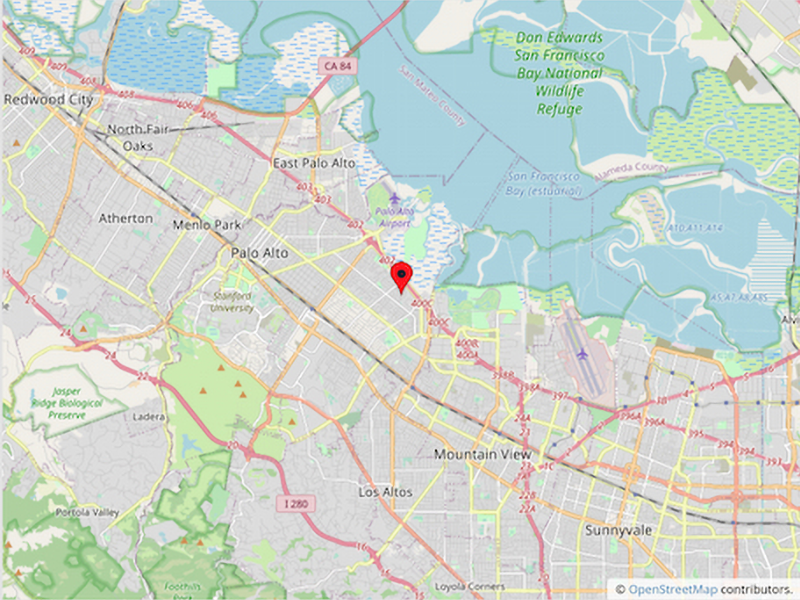
Three miles from the Bay and eight from the crest of the Santa Cruz Mountains. The Bay is close enough to moderate the temperature. The Santa Cruz Mountains stand between Palo Alto and the Pacific, holding back most of the marine layer and fog and wringing out much of the rain before it arrives. So the summers are mild and dry, the fog is lighter than on the coast, and the rain is far less than the ridge gets.
The instruments
This machine
- Signal quality
- 98%
- Transmitter battery
- OK
- Envoy battery
- 3.9 V
- Host
- charlemagne5t
- Operating system
- Linux 6.18.60+rpt-rpi-2712
- Server uptime
- 3 d 15 h 54 m
- WeeWX uptime
- 2 d 18 h 23 m
- VM size
- —
- VM RSS
- —
- Shared
- Data
- —
- WeeWX
- 5.5.2
- Skyfield
- 1.55
- Python
- 3.13.5
- Skin
- Tempestas 1.65
Credits
Data we are given
- ForecastsNWS
- KMUX radarNWS
- GOES-18 / WestNOAA
- Tide harmonicsNational Ocean Service
- EphemerisJet Propulsion Laboratory
- Star catalogESA
- Star namesIAU
- Twilight definitionsUS Naval Observatory
- Air monitor and air forecastBay Area Air District
- Air data, preliminaryEPA AirNow
- Fire detectionsNASA FIRMS
- Fire namesNIFC
- Fire incident pagesCAL FIRE
- The fires mapNatural Earth
- UV forecastEPA, NOAA CPC
- Airport reports (METAR)NWS Aviation Weather Center
The software underneath
Art and marks

Written here
All but the skin are published; anyone can install them. Each was written for this station to be its first user, and being used here every day is why they work.
PurpleAir readings carry the EPA correction and the 2024 EPA AQI update. The wet bulb globe temperature on the Gauges page is the WBGT, Version 1.1, of James C. Liljegren of Argonne National Laboratory, ported to JavaScript. This product includes software produced by UChicago Argonne, LLC under Contract No. DE-AC02-06CH11357 with the Department of Energy. We acknowledge the use of data and/or imagery from NASA’s Fire Information for Resource Management System (FIRMS), part of NASA’s Land, Atmosphere Near real-time Capability for Earth observations (LANCE) and NASA’s Earth Science Data and Information System (ESDIS).
Systems fed by PaloAltoWeather.com
The photographic recordnewest first · click any photograph to enlarge
The rooftop today
The computer rack today
Tempestas is born
LiveSeasons, the skin behind the site, is completely rewritten and renamed Tempestas, Latin for weather and season.
Carbon dioxide reporting goes live
AirGradient Open Air
Also tracking TVOC and NOx.
Weather station returned to the rooftop
The primary station and the TB3 rain gauge went back up. The secondary Vantage Pro2 and the TB7 did not.
Rooftop construction
Foam roof and solar array
Solar supports in and the deck stripped on April 10.
Foam sprayed April 23. Panels up May 1.
Construction shows up in the data
The station spent six weeks off the roof. Its UV, solar radiation and wind readings for that period are compromised.
Bulky Davis consoles replaced by Envoys
Servers move to Raspberry Pi 5
A mix of NUC 7i5 and older Raspberry Pi servers becomes Raspberry Pi 5 8 GB throughout. Web traffic is served from a Google Compute Engine instance.
PurpleAir Flex installed
PurpleAir PA-II-Flex
Retired May 25, 2024
The rooftop before the foam roof and solar
Primary station at right, secondary in the background, TB3 in the foreground and the TB7 behind it.
HyQuest Solutions TB7 backup rain gauge installed
Off the roof April 10, 2025 — still on site, not operational
Second Davis Vantage Pro2 Plus installed
Davis Vantage Pro2 Plus 6163
Designated primary September 18, 2022
The station reading on this site today.
HyQuest Solutions TB3 rain gauge installed
An integrated siphon holds the calibration across a wide range of rainfall intensity. The gauge behind the rain numbers today.
RainWise industrial rain gauge installed
An eight-and-a-half-inch collector.
Retired November 24, 2022
RainWise rain gauge installed
An eight-inch collector, to the NWS specification. In service seven weeks.
Retired November 23, 2020
Davis air quality sensor installed
Davis AirLink
Evaluated alongside the PurpleAir rather than replacing it.
Retired February 15, 2023
Second weather station installed
Davis Vantage Pro2 Plus 6163
Primary September 5, 2020 · secondary September 18, 2022
Installed for testing, primary four days later. UV and solar radiation enter the record here.
Off the roof April 10, 2025 — still on site, not operational
Air quality reporting goes live
PurpleAir PA-II-SD
Two laser particle counters in one housing, each checking the other. The PA-II-SD, the Classic and the Classic Plus are successive revisions of the same sensor, so PurpleAir monitoring here has been continuous from this date.
Seismograph upgraded
Raspberry Shake 3D — AM.R24AE
Still the instrument behind the Earthquakes pages today.
Infrasound monitor goes live
Raspberry Boom — AM.RE991
Infrasound: pressure changes below 20 Hz, under the limit of hearing, from a microbarometer.
Retired November 24, 2022
Seismograph goes live
Raspberry Shake 4D — AM.R3C71
Four channels — one geophone and a three-axis accelerometer.
Kept recording beside the 3D until May 27, 2024
PaloAltoWeather.com goes live
A vanilla install of the WeeWX weather software package with its unmodified Seasons skin.
Reporting to the National Weather Service begins
Station F4751, APRSWXNET/CWOP
From this day the station is part of the national observation network, not just a private record.
See this station on weather.gov
RainWise weather station installed
RainWise Mark III-LR
Everything in the weather record before September 2020 came from this station.
Retired September 18, 2022
The full-size photograph is fetched only when you open it.